




New analysis has found that ChatGPT can accurately diagnose common car faults, but drivers have been advised against carrying out at-home repairs.
FixMyCar teamed up with London-based repairer Inderjit Matharu from Mobile Mechanics and Tyres to assess the ability of ChatGPT to identify car problems and offer repair advice.
It asked the AI chatbot a series of questions and measured the responses against expert opinion.
The prompts included:
- My car is having trouble changing gears, there is a grinding sound. What could the diagnosis be?
- My car is making a knocking sound when driving. What could the diagnosis be?
- My car has a smell of burning rubber when driving. What could the diagnosis be?

Proper tools
Matharu said: “Overall, the responses are broadly accurate and follow a logical diagnostic flow that a professional technician would recognise. Most importantly though, nothing listed by ChatGPT is inherently inaccurate or dangerous.
“However, it is worth noting that some steps, such as checking transmission fluid, clutch evaluation, or internal transmission issues, require proper tools, access, and experience to diagnose correctly.
“ChatGPT is suitable for understanding possible causes, but not for assisting self-repair. It provides a reasonable overview that could help drivers better understand possible issues, but it does not replace professional diagnosis.
“Drivers should treat this information as general guidance only. Professional inspection and confirmation by a qualified technician is always recommended.”
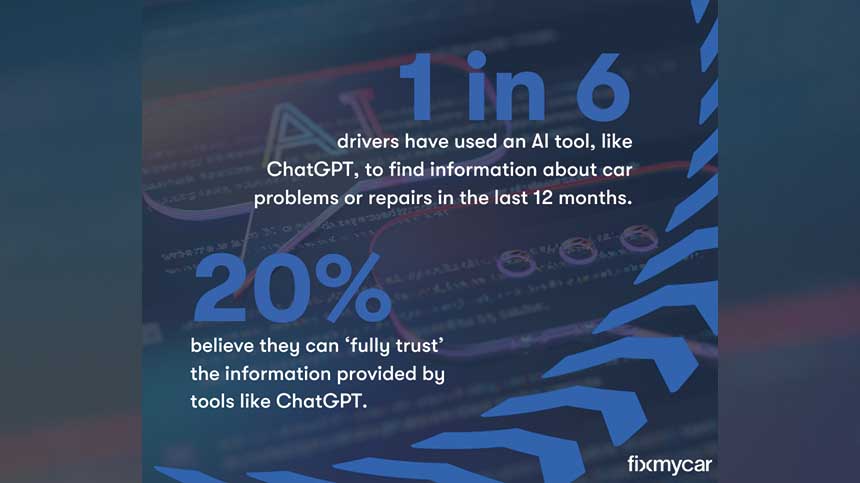
The research comes after a recent survey of over 2,500 drivers found that 16% of drivers said they have used AI, like ChatGPT, to get information about car problems or repairs in the last 12 months. Meanwhile, another poll found that 20% of respondents believe they can trust ChatGPT to provide accurate repair and maintenance information.
Professional diagnosis
Matt Wrankmore, head of garage networks at FixMyCar, added: “It’s not surprising, given the rising popularity of AI tools, that drivers are turning to ChatGPT for advice about their cars. Our analysis shows that ChatGPT can be trusted to provide guidance on car problems and to fairly accurately suggest the repair steps required.
“But just as you should trust a doctor’s expert opinion over what you find on Google, I advise drivers to trust a professional mechanic’s diagnosis before taking action based on ChatGPT’s advice.”
