




Car touchscreens driving motorists to distraction, study warns
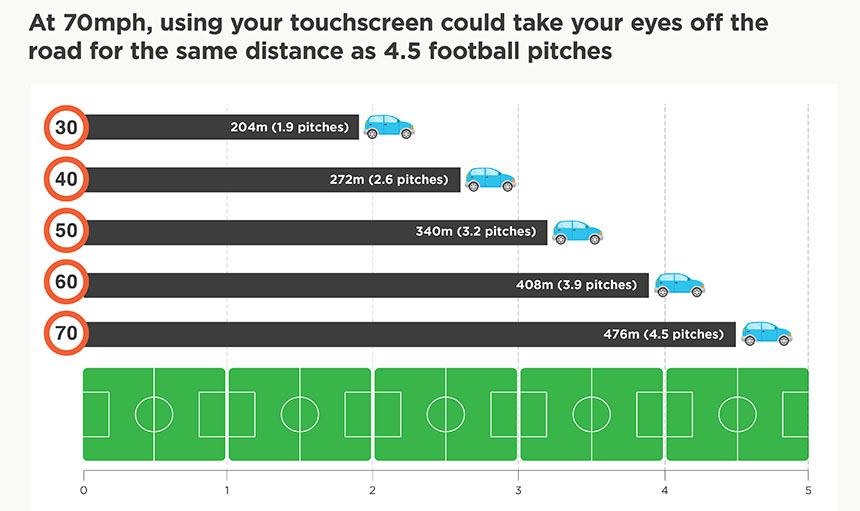
New research has revealed that setting sat-nav destinations on car touchscreens takes a driver’s attention away from the road for long enough to cover 476 metres at motorway speed – the length of four-and-a-half football pitches.
In modern cars, touchscreens have replaced the dials and buttons that drivers once operated by feel alone. This means that tasks that used to take a fraction of a second now involve working through layered on-screen menus, and those extra seconds soon add up fast at speed.
Car touchscreens blamed for distracted drivers
In the research, Scrap Car Comparison converted task-completion times from touchscreen distraction test data into distances travelled at speeds between 30mph and 70mph. The test timed a panel of drivers completing five common in-car touchscreen tasks, including setting a sat-nav destination, turning off lane-keep assist and tuning the radio, across 10 leading car brands.
Scrap Car Comparison also surveyed 1,000 UK drivers who own a car with a touchscreen system, to find out how they feel about the technology and how often it causes problems on the road.
Setting a sat-nav distracts drivers most
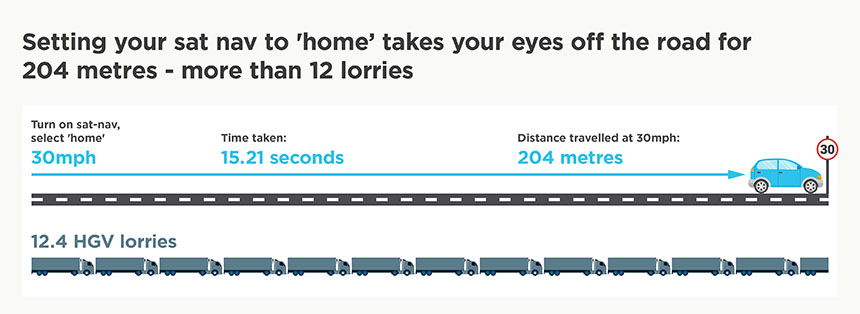
Of the tasks timed, instructing the sat-nav to navigate home takes longest at an average of 15.21 seconds. At 30mph that is enough time to travel 204 metres, or 1.9 football pitches, without full attention on the road.
Turning off lane-keep assist takes almost as long at 12.67 seconds, covering 170 metres at 30mph. That is the equivalent length of roughly 15 Routemaster buses or 10 HGV lorries lined up end to end.
The same 15.21 seconds covers very different distances depending on how fast the car is moving. At 30mph it is 204 metres. At motorway speeds (70mph) it is 476 metres, or 42 Routemaster buses parked nose to tail.
Genesis owners take longest
Averaged across all five tasks, Genesis owners take their eyes off the road for the longest while using their car touchscreens, at 14.04 seconds – at this distance, drivers could cover up to 188 metres at 30mph. Peugeot drivers follow in second (10.96 seconds) and Ford in third (10.50 seconds). Skoda owners take the least time at 5.32 seconds, covering around 71 metres, with Mercedes (7.10 seconds) and Volvo (7.36 seconds) also among the fastest.
The gap ultimately comes down to how each brand designs its menus. Deeper menu structures, smaller touch targets and a lack of physical shortcut buttons all add seconds to a task that should be simple.
Drivers want physical buttons back
More than half of drivers with car touchscreens (54%) say the technology makes simple tasks harder to complete quickly than buttons would, and 51% wish manufacturers still fitted physical dials for key functions. Four in 10 (42%) have avoided buying or leasing a car because its main controls are touchscreen-only, while a quarter (25%) have chosen a different model or brand as a result.
London drivers are most likely to have rejected a car over its touchscreen, at 53%, followed by Cardiff at 50%. Bristol (24%) and Edinburgh (25%) based drivers are the most relaxed about it.
Sat-nav entry tops the list of tasks drivers find the most distracting to do safely (41%), followed by changing the radio station (29%) and answering a phone call (26%).
10% have been in a collision after being distracted by car touchscreens
Almost a quarter of drivers (24%) report having missed a turning or exit because of their car touchscreens, while more than a fifth (22%) have had to brake suddenly. A further one in five have swerved to correct their lane position (21%) or clipped a kerb or pavement (18%), while 13% have had a near-miss with another vehicle, cyclist or pedestrian. More seriously, 11% have been in a minor collision, and one in 10 (10%) have been in a serious collision.
Matt Clamp, car scrappage expert at Scrap Car Comparison, said about car touchscreens: “Most people assume setting a sat-nav is a two-second job, but the data puts it closer to 15 seconds, which means that people could cover almost 500 metres of road while doing so at motorway speed. That’s a long stretch to cover without paying attention to the road. My advice would be, if a touchscreen task can wait until the car is stopped, then it should.”
